
 Qamer Javed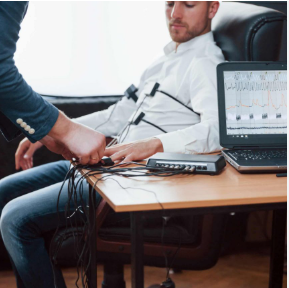
If you’ve ever watched a crime show or a true-crime documentary, you’ve probably seen the dramatic moment when someone’s hooked up to a polygraph test. The tension builds. Fingers twitch. The machine beeps. And somehow, everyone’s waiting for that needle to betray the truth. But here’s the thing: life isn’t always like TV. A polygraph test—commonly called a lie detector—might not be the crystal-clear truth serum we imagine.
I remember a friend of mine getting called in for a routine polygraph at a job he really wanted. He’d never been in trouble in his life, but he told me afterward, “I felt like I was sweating for no reason. Every heartbeat felt loud, every breath suspicious.” That’s kind of the point—polygraphs don’t detect lies directly. They measure stress responses: heart rate, blood pressure, respiration, skin conductivity. Your body’s reactions. So if you’re nervous, anxious, or just naturally fidgety, that machine might think you’re hiding something you’re not.
How a Polygraph Test Actually Works
Let’s back up for a second. A polygraph test isn’t reading your mind. It’s more like eavesdropping on your body. The examiner straps on sensors: one around your chest to measure breathing, one on your arm for blood pressure, another on your fingers for skin conductance. Then they ask questions, usually a mix of “control” questions and the real ones they care about.
The idea is simple. If you answer a question with physiological spikes—sweaty palms, faster heartbeat—it suggests stress. Stress is often associated with lying, but not always. You could just be stressed because the examiner is intimidating or because you’re scared of failing the test. Or maybe you just had a triple espresso beforehand. That can make your heart race, too.
Here’s a scenario I’ve heard a few times: A bank teller is taking a polygraph to investigate a missing sum of money. She’s innocent, but she knows she’s under suspicion. As the examiner asks about the missing cash, her hands sweat, her breathing gets uneven, and her pulse spikes. The machine interprets stress. Not lies—but that’s what it detects. And this happens a lot.
The Myth of “Lie Detection”
People love to believe a polygraph is an infallible truth detector. Hollywood has made it feel like it can literally reveal your soul. But real life is messier. Polygraph results are often contested in courts, and many experts argue they’re only about 70-90% accurate under the best conditions—and that’s in ideal settings with trained examiners. That leaves a significant chance for false positives or false negatives.
Here’s a simple way to understand it: imagine a smoke detector that goes off when it senses smoke, but also occasionally when you’re cooking bacon. Does that mean there’s always a fire? No, sometimes it’s just reacting to normal conditions. Polygraphs are a lot like that—they respond to stress, not lies directly.
Why People Agree to Take Them
Despite the uncertainty, polygraphs are still widely used. Jobs in law enforcement, government agencies, and security-sensitive positions often require them. And here’s the interesting part: a lot of people consent because they feel they have to, or because they believe the test will clear them. Some think, “I have nothing to hide, so this will prove it.” Others might feel intimidated but go along anyway.
One cousin of mine had to take one for a security clearance. He told me afterward, “I knew I hadn’t done anything wrong, but sitting there, answering questions about stuff from ten years ago, I couldn’t help but sweat. The machine doesn’t know my life history—it just reacts to me.” It’s a reminder that these tests are as much psychological as physiological. Nervousness doesn’t equal guilt.
Can You Beat a Polygraph?
People love tricks. Books, forums, even YouTube videos promise ways to “trick” the polygraph. Some suggest biting your tongue or thinking about something stressful during control questions. Others recommend controlled breathing or tensing muscles to create false readings. But let’s be honest—most of that is hit or miss. Experienced examiners know about common tactics, and some methods can backfire spectacularly.
Even more, trying to cheat a polygraph can make you more stressed. Imagine trying to consciously control your heart rate while someone asks you about serious wrongdoing. Chances are, your body’s going to betray you anyway. That stress spike, ironically, can make the machine think you’re lying more than if you were just honest and nervous.
When Polygraphs Are Useful—and When They Aren’t
Here’s where it gets interesting. Polygraphs can sometimes be helpful tools in investigations or security screenings, but they’re not standalone proof. They’re most useful when combined with other evidence or intelligence. Think of them like a first impression: they might highlight something worth looking at more closely, but they don’t settle the question on their own.
In contrast, relying solely on polygraphs to make high-stakes decisions—like firing someone, denying a job, or convicting someone in court—is risky. Human physiology is complicated. Emotions, medical conditions, and even caffeine can influence readings. Treating the results as absolute truth is like judging a book by the color of its cover. It might give you a clue, but it’s far from the whole story.
The Human Factor
One of the most overlooked aspects is the examiner. A skilled polygraph examiner doesn’t just read numbers—they observe microexpressions, hesitation, and overall behavior. Their experience shapes the test as much as the machine does. And here’s the kicker: even the best examiner can’t separate stress from deceit perfectly. It’s a human-and-machine collaboration, not a crystal ball.
I’ve spoken to a retired examiner who said something that stuck with me: “It’s not about catching liars. It’s about observing patterns, seeing who’s calm, who’s tense, and using that to guide the investigation. People think it’s black and white. It’s shades of gray.” That perspective changes the way you look at the whole process. It’s less about proving guilt and more about guiding questions, narrowing down possibilities.
The Psychological Impact
Taking a polygraph can be intense. Even if you know you’re innocent, the test can create anxiety, self-doubt, and second-guessing. Some people report feeling like they were interrogated rather than evaluated. Others find it empowering if they feel they passed. Either way, the experience leaves a mark.
Imagine being asked intimate questions while attached to a machine, feeling every heartbeat magnified. You’re hyper-aware of your reactions. That’s stress, pure and simple. And stress is exactly what the polygraph is designed to detect. It’s almost a paradox: your body’s natural response to being tested can make you seem guilty when you’re not.
Legal Status and Limitations
Polygraphs aren’t universally admissible in court. In the U.S., for example, federal law often limits their use in employment decisions, though some agencies still rely on them. Many states have strict rules about when results can be presented. That’s because of their inherent uncertainty. Judges and lawyers know that a physiological response doesn’t equate to a criminal act.
Around the world, the rules vary widely. Some countries use them routinely in security clearances. Others treat them almost as a curiosity. This patchwork reflects the ongoing debate: useful tool, or unreliable relic? Most experts fall somewhere in between, treating them as a piece of the puzzle rather than the whole picture.
What You Should Take Away
Here’s the bottom line. Polygraph tests measure stress, not lies. They can highlight areas of concern, guide questioning, and sometimes support investigations. But they’re far from infallible. A spike in heartbeat doesn’t prove guilt, and a calm demeanor doesn’t guarantee honesty. Human emotions, medical factors, and individual differences complicate everything.
If you ever face one, the best approach is simple: stay calm, answer truthfully, and don’t obsess over the machine. The body reacts to stress, not morality. That awareness alone can help you navigate the experience without adding unnecessary anxiety.
So the next time you see a polygraph on TV, remember: the drama is real, but the science is subtle. Those needles don’t tell the whole story—they only tell part of it. And maybe that’s okay. Life, like truth, is rarely binary. Sometimes, it’s just a pulse, a breath, and a human reaction trying to make sense of it all.