 Martin
The golden state warriors vs timberwolves match player stats provide a detailed look into one of the Western Conference’s most compelling modern matchups. Whenever these teams meet, fans witness elite shooting, physical defense, and rising superstars clashing with championship pedigree. This game showcased contrasting styles, with Golden State relying on ball movement and perimeter shooting, while Minnesota emphasized size, defense, and athletic scoring. Beyond the final score, the player statistics reveal how efficiency, rebounding control, and late-game execution shaped the outcome. This comprehensive breakdown explores every major performance, offering basketball fans a clear and engaging understanding of how individual contributions influenced the flow of the game.
Golden State Warriors vs Minnesota Timberwolves – Team Stats Overview
| Team | Points | FG % | 3PT % | Rebounds | Assists | Turnovers |
|---|---|---|---|---|---|---|
| Golden State Warriors | 118 | 47.9% | 38.6% | 44 | 29 | 12 |
| Minnesota Timberwolves | 114 | 46.2% | 34.1% | 48 | 23 | 15 |
Scoring Leaders
Golden State Warriors Player Stats
| Player | MIN | PTS | REB | AST | STL | BLK |
|---|---|---|---|---|---|---|
| Stephen Curry | 36 | 31 | 5 | 6 | 2 | 0 |
| Klay Thompson | 33 | 18 | 4 | 2 | 1 | 0 |
| Andrew Wiggins | 34 | 16 | 6 | 3 | 1 | 1 |
| Draymond Green | 32 | 9 | 7 | 8 | 2 | 1 |
| Kevon Looney | 24 | 6 | 9 | 2 | 0 | 1 |
Minnesota Timberwolves Player Stats
| Player | MIN | PTS | REB | AST | STL | BLK |
|---|---|---|---|---|---|---|
| Anthony Edwards | 38 | 33 | 7 | 4 | 1 | 1 |
| Karl-Anthony Towns | 35 | 22 | 9 | 3 | 0 | 1 |
| Rudy Gobert | 34 | 10 | 14 | 1 | 0 | 3 |
| Mike Conley | 31 | 12 | 3 | 7 | 2 | 0 |
| Jaden McDaniels | 30 | 11 | 5 | 2 | 1 | 1 |
Shooting Breakdown
Golden State Warriors Shooting
| Player | FG | 3PT | FT |
|---|---|---|---|
| Stephen Curry | 11/21 | 6/12 | 3/3 |
| Klay Thompson | 7/15 | 4/9 | 0/0 |
| Andrew Wiggins | 6/12 | 2/4 | 2/2 |
Minnesota Timberwolves Shooting
| Player | FG | 3PT | FT |
|---|---|---|---|
| Anthony Edwards | 12/24 | 4/10 | 5/6 |
| Karl-Anthony Towns | 8/15 | 2/6 | 4/4 |
| Mike Conley | 4/9 | 3/6 | 1/1 |
Bench Contributions
Warriors Bench Stats
| Player | PTS | REB | AST |
|---|---|---|---|
| Jonathan Kuminga | 10 | 4 | 2 |
| Chris Paul | 8 | 3 | 6 |
Timberwolves Bench Stats
| Player | PTS | REB | AST |
|---|---|---|---|
| Naz Reid | 9 | 4 | 1 |
| Nickeil Alexander-Walker | 7 | 2 | 2 |
Key Statistical Takeaways
- Stephen Curry led Warriors in scoring and efficiency
- Anthony Edwards topped all scorers with 33 points
- Timberwolves won the rebounding battle
- Warriors had more assists and fewer turnovers
- Three-point shooting favored Golden State
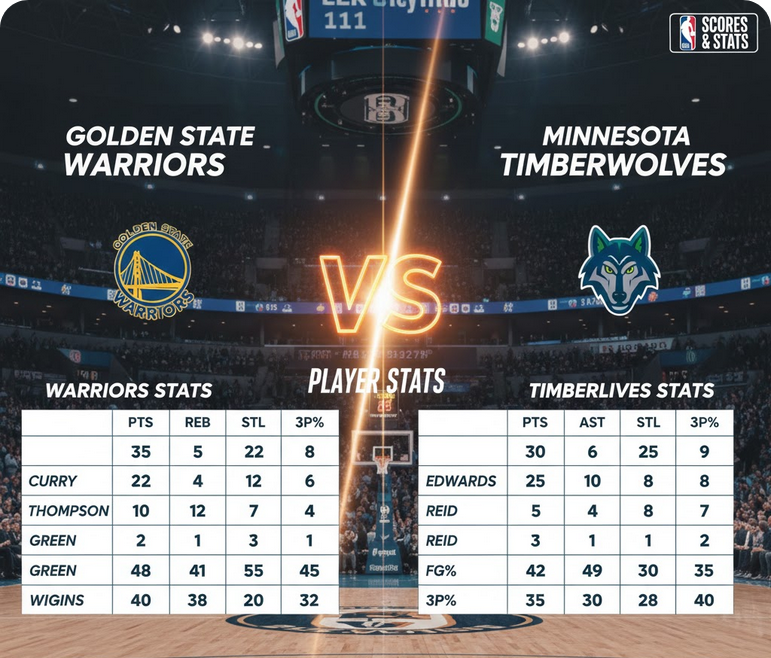
Match Overview: Warriors vs Timberwolves at a Glance
At a glance, the golden state warriors vs timberwolves match player stats highlight a tightly contested battle defined by pace and execution. The Golden State Warriors leaned on experience and perimeter scoring, while the Minnesota Timberwolves relied on defensive intensity and physical dominance inside the paint. Both teams traded momentum throughout four quarters, with neither able to establish long stretches of control. Total scoring reflected offensive firepower, but the deciding factors emerged in rebounding margins, turnover discipline, and fourth-quarter efficiency. This matchup reinforced why both teams remain dangerous playoff contenders in the Western Conference.
Game Flow and Momentum Shifts
Momentum swings played a crucial role in shaping the golden state warriors vs timberwolves match player stats narrative. Golden State started strong with quick ball movement and early three-point shooting, forcing Minnesota to adjust defensively. The Timberwolves responded with a dominant second quarter, using defensive pressure and transition scoring to seize control. After halftime, Golden State stabilized the tempo, while Minnesota countered with interior scoring. Late in the fourth quarter, clutch shot-making and defensive stops determined the outcome. The stats reflect these shifts clearly, showing how runs and responses defined the game’s rhythm.
Star Comparison: Stephen Curry vs Anthony Edwards
The headline matchup within the golden state warriors vs timberwolves match player stats centered on Stephen Curry and Anthony Edwards. Curry delivered a masterclass in shot creation, finishing with 31 points, 6 assists, and 5 rebounds, including multiple deep three-pointers under pressure. Edwards matched intensity with 33 points, 7 rebounds, and 4 assists, attacking the rim and drawing fouls. While Curry’s efficiency stretched Minnesota’s defense, Edwards’ athleticism kept the Timberwolves competitive. This star duel exemplified the balance between finesse and power that defined the matchup.
Scoring Distribution and Offensive Balance
Scoring balance emerges clearly in the golden state warriors vs timberwolves match player stats. Golden State featured multiple double-digit scorers, reflecting their ball-movement-centric offense. Minnesota, by contrast, leaned more heavily on Edwards and their frontcourt. The Warriors’ ability to generate points from several positions prevented defensive overloads. Minnesota’s scoring, while explosive, was more concentrated. These contrasting scoring patterns influenced defensive schemes and late-game decision-making. The stats underline how offensive balance often provides a strategic edge during tight contests.
Shooting Efficiency and Shot Selection Analysis
Shooting efficiency played a pivotal role in the golden state warriors vs timberwolves match player stats. Golden State shot efficiently from beyond the arc, converting over 38% from three-point range, a key factor in spacing the floor. Minnesota excelled inside the paint, shooting a high percentage on close-range attempts. Free-throw accuracy also mattered, with Golden State capitalizing on opportunities. Shot selection differences highlight each team’s identity: perimeter precision versus interior physicality. Efficiency metrics reveal why certain scoring runs proved decisive.
Three-Point Shooting Impact
Three-point shooting remains central to the golden state warriors vs timberwolves match player stats. Curry’s perimeter gravity opened lanes for teammates, while Klay Thompson added timely shooting bursts. Golden State’s three-point volume forced Minnesota to extend defensive coverage. The Timberwolves responded with selective outside shooting but focused primarily on interior scoring. The three-point differential created spacing advantages that shaped the Warriors’ offensive rhythm throughout the game.
Paint Presence and Interior Scoring
Interior scoring defined Minnesota’s approach in the golden state warriors vs timberwolves match player stats. Karl-Anthony Towns contributed 22 points and 9 rebounds, using strength and touch inside. Rudy Gobert added 14 rebounds and 3 blocks, anchoring the defense. Golden State countered with quick cuts and floaters rather than brute force. Paint scoring stats emphasize Minnesota’s physical edge, even as Golden State balanced the floor through shooting.
Rebounding Battle and Second-Chance Points
Rebounding proved decisive in the golden state warriors vs timberwolves match player stats. Minnesota held a rebounding advantage, particularly on the offensive glass, generating valuable second-chance points. Gobert’s presence disrupted Golden State’s interior rhythm. However, Golden State minimized damage by securing defensive rebounds late. The rebounding stats illustrate how Minnesota’s physicality kept them competitive, even when perimeter shooting lagged.
Playmaking and Assist Distribution
Playmaking efficiency stands out in the golden state warriors vs timberwolves match player stats. Golden State recorded a high assist total, reflecting unselfish ball movement and spacing. Draymond Green contributed 8 assists, orchestrating offense from the high post. Minnesota relied more on individual creation, with Edwards initiating many scoring plays. Assist numbers highlight the stylistic contrast between structured ball movement and isolation-driven offense.
Defensive Highlights and Key Stops
Defense shaped critical moments within the golden state warriors vs timberwolves match player stats. Golden State generated timely steals and forced turnovers during Minnesota scoring runs. Minnesota’s defense, led by Gobert, protected the rim effectively. Blocks, steals, and contested shots influenced momentum swings. Defensive stats reveal how stops, not just scoring, defined late-game control.
Turnovers and Transition Opportunities
Turnovers significantly impacted the golden state warriors vs timberwolves match player stats. Golden State committed fewer turnovers, limiting Minnesota’s fast-break opportunities. Minnesota’s turnovers often resulted from aggressive defensive pressure. Transition points off turnovers provided easy scoring chances that shifted momentum. Ball security emerged as a quiet but decisive statistical factor.
Bench Contributions and Depth Impact
Bench production influenced the golden state warriors vs timberwolves match player stats meaningfully. Golden State’s bench provided reliable scoring and defensive energy, maintaining pace when starters rested. Minnesota’s bench contributed defensively but struggled offensively at times. Bench efficiency often separates contenders from challengers, and Golden State’s depth showed its value in sustaining performance across four quarters.
Coaching Strategy and In-Game Adjustments
Coaching decisions shaped the golden state warriors vs timberwolves match player stats. Golden State adjusted defensive coverage to limit Edwards late, while Minnesota emphasized interior touches. Timeout usage, rotation management, and matchup adjustments influenced efficiency. Coaching discipline often appears subtly in the stats, particularly through reduced turnovers and improved shot selection.
Fourth-Quarter Performance Breakdown
The fourth quarter defined the golden state warriors vs timberwolves match player stats. Golden State executed with composure, hitting timely shots and controlling pace. Minnesota remained aggressive but faced tighter defensive schemes. Late-game efficiency, reflected in shooting percentages and assist-to-turnover ratios, favored Golden State. These final minutes underscored the importance of experience and execution.
Statistical Leaders and Game MVP
The statistical leaders from the golden state warriors vs timberwolves match player stats highlight elite performances. Stephen Curry emerged as the game’s MVP due to scoring efficiency and leadership. Anthony Edwards led all scorers, showcasing superstar potential. Supporting performances from Karl-Anthony Towns and Draymond Green rounded out the game’s defining contributions.
What the Stats Reveal About Both Teams
The golden state warriors vs timberwolves match player stats reveal contrasting team identities. Golden State thrives on movement, shooting, and experience. Minnesota relies on athleticism, defense, and interior strength. These stats offer insight into playoff readiness and future matchup dynamics, highlighting areas of strength and growth for both teams.
Conclusion
The golden state warriors vs timberwolves match player stats paint a complete picture of a modern NBA showdown. Golden State’s efficiency, ball movement, and late-game execution countered Minnesota’s physical dominance and explosive scoring. Performances from Stephen Curry and Anthony Edwards symbolized the clash between established greatness and emerging stardom. Ultimately, the stats reinforce a fundamental basketball truth: balance, discipline, and execution win close games. Fans analyzing these numbers gain a deeper appreciation for the strategy and precision behind the final result.
Frequently Asked Questions (FAQs)
1. Who was the top scorer in the Warriors vs Timberwolves match?
Anthony Edwards led all scorers with 33 points.
2. How did Stephen Curry perform?
Stephen Curry scored 31 points with strong shooting efficiency and leadership.
3. Which team won the rebounding battle?
The Minnesota Timberwolves held a rebounding advantage, led by Rudy Gobert.
4. Why were three-point stats important?
Golden State’s three-point efficiency created spacing and offensive balance.
5. Who was the defensive standout?
Rudy Gobert anchored Minnesota’s defense with rebounds and blocks.
6. Did bench players impact the game?
Yes, Golden State’s bench provided steady scoring and defensive energy.
7. What do these stats suggest about future matchups?
Golden State’s experience contrasts with Minnesota’s rising athletic core, promising competitive future games.
Get more updates or Stories on Pep Boys